Chewing scenery and celluloid. Vomiting.

Showing posts with label american. Show all posts

Sunday, November 7, 2010

I like 'em crispy


The notoriety of the Norwegian black metal scene of the late 80s/early 90s is something which typically precedes the music itself. Whilst digging around for clips about it, some musician (don't ask me who because the group of bands associated with this stuff, good or bad, is fucking mammoth) mentioned that one of the ironies of black metal becoming a trend is that it was never meant to be anything more than self-gratification for the people who were making the records. Certainly never commercial. And yet in 2009 we get Until the Light Takes Us, probably the documentary on the Norwegian black metal scene with the biggest release to date.

The interview I read with directors Aaron Aites and Audrey Ewell before watching gave me a fairly good idea of what to expect i.e. "they sound like art hipsters"

I didn't love it, but there are certainly parts that I enjoyed.

Gylve "Fenriz" Nagell from Darkthrone and Varg Vikernes of Burzum immediately chalk up as the film's most interesting narrators. Fenriz seems somewhat on edge but amiable, genuinely unnerved by what "black metal" has come to mean and represent today. Vikernes is engaging and well-spoken as usual (which is part of what makes him so bothersome when you know about him and his personal beliefs).


I've heard people say that this isn't a film to watch if you don't know anything prior to, but I tend to think it's one that will actually convince people who've never heard of these bands to look into them. The major topics (Dead's suicide, Euronymous' murder, the church burnings, Vikernes' trial/imprisonment) are discussed, but not belabored or moralized as they seem to be in most other documentaries or specials that I've seen. Fenriz's visit to a Swedish art exhibit on black metal was a highlight for me. Hellhammer from Mayhem and Faust from Emperor also fill in some details.

But then there's the rest of the film. In that same interview, Aites and Ewell mention that they would've never made the Until the Light Takes Us had they not been able to get both Fenriz and Varg. Thankfully they were, but the contrast/connection they seem to want to make between the two falls slightly flat. It starts with each briefly mentioning each other, their interviews cut back and forth, but then it's sort of forgotten about, returning in a scene where Fenriz watches footage of Varg talking about him. Something similar happens when the issue of Christianity (anti-Christian beliefs were one of, if not the binding factor for these bands) and its destruction of culture is brought up. Several of the interviewees briefly remark on it, then we're given a really shitty montage of close-ups of religious statues. Aites and Ewell are walking into a goldmine. They've got some of the best people possible to discuss the history of this movement, they've got big ideas, unfortunately what's left to them outside of these people is handled amateurishly.

However, the one-on-one interviews themselves are the majority of the film and they're very solid. Until the Light Takes Us is worth watching for them alone. It's a pretty fascinating story not only because of the scandals that occurred, but how young, how dedicated, and how talented these people were and how radical some of their ideas (and certainly their music, not simply thematically, but technically) were at the time. It was an all consuming lifestyle, not some kind of trend. And yet this film is now being served up to people like myself who were in kindergarten in 1993.

P.S. Taking bets on whether or not the inclusion of that Harmony Korine bit is meant to be taken seriously or as a grim response to Fenriz's lamentation of black metal becoming trendy.

Also it's best if we not talk about the Frost stuff. At all. Except this.


Sunday, July 11, 2010

Do you know what a snatch is?


The fact that I find it mildly difficult discussing Peter Watkins' Punishment Park without bringing up my personal political opinions is a testament to how effective it is as a crash-course in radical leftist rhetoric.

Having said that, I must admit to having found the film fairly tedious. Good, but not mindblowing.

It's incredibly dated, something which acts both positively and negatively.

Positively because it serves as a perfect snapshot of America in 1970, when peaceful protesters had rapidly turned into militants, feeling that their initial approach had failed. The wearied reactions of Punishment Park's victims, dehydrated and relentlessly chased by the police, reflect the feelings of counterculture American youth at the time. Peace had failed them, and it quickly felt like violence was failing them as well. Wondering whether or not it's worth chasing the flag against the police pursuit mirrors the hangover of the summer of love.


Negatively because the film is permanently stuck in its era. The outdated speech, the clothing, the arguments, the political background. Regardless of whether or not the cores of the political issues raised by Punishment Park are still problematic today, so much of the film is so 1970, that it's impossible to say this is something that still feels "fresh" 40 years later. This is a film with essentially no humor, but there were more than a few times when I had to stifle a chuckle due to how outdated some of the dialogue is.

Everything about the film is geared towards its purpose of presenting a radical leftist view of American society in 1970. There's zero subtlety (or we can say it's "unapologetic about its politics"). This isn't hard to determine when the first shot is a zoom-in of the US flag flying backwards. While admirable, I do tend to get bored when films are as one-sided as this. The scenes following the actual prisoners in the desert quickly became more interesting than the tribunal interviews. Every question asked, whether by the fascist administration or the film crew are worded to provoke a leftist response. And not a single person in this pseudo-documentary is a poor orator. Every answer is flawless. This kind of perfection, however rough the language or passionate the speech, gets pretty dull and repetitive.

What struck me most about Punishment Park, in terms of things I liked, was its setting. It's a present day (back then, anyway) dystopia. Not a dark, decrepit undisclosed future with a vague fascist leader, but the sunny deserts of California where absolutely nothing is modernized and Nixon is clearly responsible. This is where I can understand Punishment Park being underrated in terms of its controversy and forward-thinking. The violence isn't graphic, but the explicit depiction of cops as merciless killers against civilians is also effectively jarring, even if the idea behind it ("pigs" is used nonstop by the characters) is nothing new.


It's getting a bit dull to write this, probably because I wasn't affected by Punishment Park as I'd liked to have been. The problems and arguments brought up are still relevant today, but besides the points I mentioned, I don't think the film is nearly as strong today as it was 40 years ago.

On a small note, are there other places in the US nearly as isolating and stunning as the California salt flats? Eeesh.

Tuesday, June 22, 2010

God was wrong

Over the course of the past few years (I don't know if it's me getting older or what), I've noticed a bit of a Criterion Collection backlash amongst film snob hacks. I'm not sure if this has to do with their earliest releases (Armageddon is the first one that springs to mind) or the fact that having a ready-made, readily available "canon" ruins a lot of fun, but I can't contest that their transfers are great. Plus, more often than not, I tend to be intrigued by what they release. Does this mean that Criterion is the be-all, end-all of cinema? Absolutely not. It goes without saying that tuning into its releases isn't an excuse not to look outside its boundaries, but I don't think there's any harm in its existence, by any means. Plus, they do sometimes bring movies to the States that were otherwise hard to come by here, causing me to wish they'd be more expansive (Brighton Rock, please. Les Idoles, please).

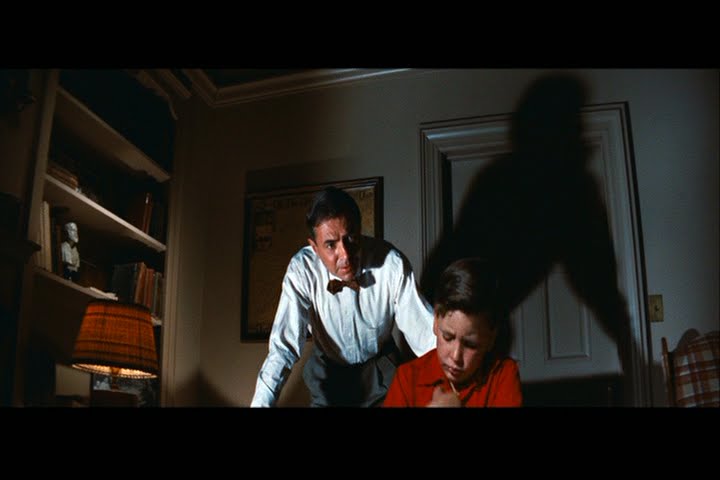
That being said, Bigger Than Life is a Criterion release!


It's kind of unfortunate that Nicholas Ray (and James Dean, for that matter) is best known for Rebel Without A Cause. I'm biased, because a) I don't like it b) it was the only Nicholas Ray movie I'd seen prior to Bigger Than Life, yet I am still comfortable making this statement!

Where most Hollywood dramas of the 1950s might have sought to show the troubles of the everyday, suburban post-war American family, Bigger Than Life might be the first one I've seen to attack the very idea of these suburban families, and viciously so. Behind the already controversial critique of modern medicine and its "wonders" is a thinly veiled ("They're dull." "So are we.") launch against the complacency of 1950s middle America. The only thing more irksome than James Mason's sudden transformation into an egomaniacal douchebag is that there are moments where you can understand where his outbursts are coming from. He's a highly unlikeable character, post-cortisone addiction, and though he may have been a stranger in 1950s American society, he sure as hell isn't in 2010.


Things spin from uncomfortably realistic to ridiculous pretty quickly, but the extent to which they become ridiculous, is satisfyingly shocking for its era (a protagonist justifying the murder of his son with the Bible? locking his wife in the closet to do so?) as well as for its typical suburban setting. Bigger Than Life is loaded with scenes and dialogue I wouldn't have dreamed of seeing or hearing in Old Hollywood. Its ending is predictable, but had Barbara Rush never gotten out of that closet, Bigger Than Life would've never seen the light of day in the U.S.